
What we do, in plain language.
No acronym soup. Here is what ABA therapy actually involves, what parent coaching adds to it, and what it looks like on your living room floor.
Small caseloads
we know your child's name
Founded by a parent
who has lived this
Applied Behavior Analysis,
explained plainly
It starts with one question:
Why is this happening?
It starts with one question: Why is this happening?
Every behavior does something for a child. It gets them something, or gets them out of something, or says something they cannot say yet.
Once we understand which, we can teach a skill that does the same job better and costs your child far less to use.
What we work on?
Communication
Asking for what you want. Saying no. Being understood by someone who is not you.
Daily living
Dressing, eating, bathroom, bedtime. The ordinary things that make a day possible.
Play and connection
Taking turns, joining in, letting somebody else into the game.
Regulation
Noticing a big feeling before it arrives, and having somewhere to put it.
Learning
Attention, problem solving, following a sequence, staying with something frustrating.
What an hour actually
looks like?
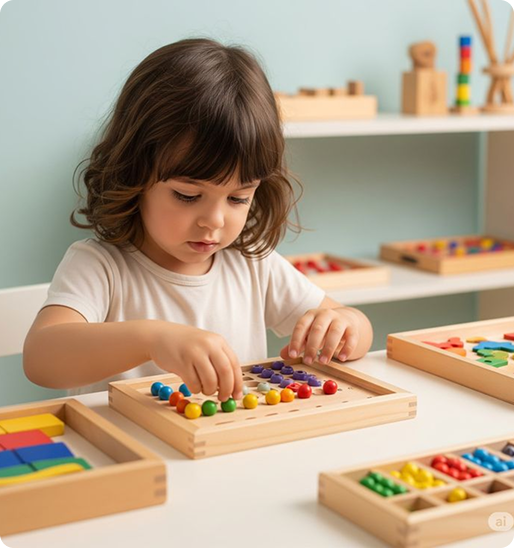
Mostly, it looks like playing.
A therapist sits on the floor and follows what your child is already interested in. Teaching gets folded into that, in small pieces, repeated often, until a skill stops feeling like work.
Sometimes there is a table involved. Often there is not. There is always data being taken quietly in the background, and there is always the option to stop.
You are welcome to be in the room. Most of the time we would prefer it.
What an hour actually
looks like?
Mostly, it looks like playing.
A therapist sits on the floor and follows what your child is already interested in. Teaching gets folded into that, in small pieces, repeated often, until a skill stops feeling like work.
Sometimes there is a table involved. Often there is not. There is always data being taken quietly in the background, and there is always the option to stop.
You are welcome to be in the room. Most of the time we would prefer it.
Three settings. One standard of care.

Home-based
Skills learned in the kitchen tend to stay in the kitchen. Home-based sessions use the routines your child already has, and remove a transition from a day that probably has enough of them already. You are welcome in the room, and most of the time we would prefer it.

Center-based
Our center is a calm, engaging space designed for children rather than adapted for them. It suits children who are ready to work somewhere new, and it offers fewer distractions than a busy household can.

Childcare and preschool-based
We work inside your child's daycare or preschool, alongside the staff who see them every day. That means strategies get used consistently by everyone, not only during our hours.
Many families use more than one setting, and the mix changes over time. We will recommend what fits your child, and revisit it when it stops fitting.
What every family gets, whichever
setting you choose
- An individualized plan built around your child, shown to you before it starts
- A Board Certified Behavior Analyst supervising the work and answerable for it
- Guidance on routines, school, transitions and behavior whenever you need it
- Parent coaching and consultation included as part of your child's treatment plan when clinically appropriate
- Progress updates in plain language, on a schedule you can rely on
- A team you can actually reach, who know your child by name
The techniques we use, translated
Positive reinforcement. When something good follows a skill, the skill is more likely to happen again. The good thing is chosen by your child, not by us
Task analysis. Breaking something large, like getting dressed, into steps small enough to succeed at.
Prompting and fading. Giving just enough help to get it right, then removing that help deliberately so independence is the goal rather than an accident.
Modeling and shaping. Showing what it looks like, then rewarding closer and closer approximations rather than waiting for perfect.
Natural environment teaching. Using real moments as they happen rather than manufacturing practice at a table.
Techniques are selected and delivered by trained clinicians and adjusted continually based on your child's progress and comfort.
Why we count things
Data has a mixed reputation with parents, and sometimes it has earned it.
We collect it because memory is unreliable. Without data, "he seems better lately" is a guess. With it, we can see that requesting went from twice day to nine times a
day, and we can tell whether a strategy is working long before we have spent three months on it.
Data never comes before your child's comfort. If a session needs to stop, it stops, and we record that too, because that is information as well.
Everything is reviewed by supervising clinicians and shared with you in language that does not require translation.
About the criticism of ABA
If you have researched this online, you have read hard things about ABA. Autistic adults describing
therapy that taught them to mask, to comply, and to look less like themselves.
That criticism is real and it comes from real experiences. Any provider who waves it away is not
worth trusting with your child.
Here is our answer. We do not target behaviors because they look unusual. Stimming is not a goal.
Eye contact is not forced. We follow your child's lead, we watch for assent, and we stop when a child
tells us they are done, in whatever way they tell us.
We measure success by whether your child's world gets bigger, not by whether they get quieter. If you want to ask us something harder than this, please do.
About the criticism of ABA
If you have researched this online, you have read hard things about ABA. Autistic adults describing therapy that taught them to mask, to comply, and to look less like themselves.
That criticism is real and it comes from real experiences. Any provider who waves it away is not worth trusting with your child.
Here is our answer. We do not target behaviors because they look unusual. Stimming is not a goal. Eye contact is not forced. We follow your child’s lead, we watch for assent, and we stop when a child tells us they are done, in whatever way they tell us.
We measure success by whether your child’s world gets bigger, not by whether they get quieter. If you want to ask us something harder than this, please do.
Getting started, step by step
GETTING STARTED
Getting started, step by step
1
Check what your
plan needs
Requirements differ. Most private plans need a documented autism diagnosis and a referral from a licensed physician or psychologist.
2
Intake
A short call, then paperwork we walk you through rather than mail you out.
3
Assessment and
plan
A BCBA assesses your child and builds an individualized plan with you, not for you.
4
Sessions and
collaboration
Work begins at home, with ongoing supervision, regular review, and coordination with schools and other therapists where it helps.
When you need something we do not offer
Speech therapy. Occupational therapy. In-classroom aides. Social skills groups. We do not provide these, but we know who does, and we will help you get there.
Referrals and coordination are part of what we do, whether or not the destination is us.
Speech therapy. Occupational therapy. In-classroom aides. Social skills groups. We do not provide these, but we know who does, and we will help you get there.
Referrals and coordination are part of what we do, whether or not the destination is us.
Ready to talk it through?
One short conversation will tell you more than another hour of reading.